Green around the eyes at El Mahasna, before the pharaohs
In a plundered grave at El Mahasna, excavators found the head of a baked clay figure. The face was painted dark red and the eyebrows nearly black. The eyelids were outlined with a broad light-green band, and the space inside was coloured black or very dark red. In their 1911 report, E. R. Ayrton and W. L. S. Loat wrote that it was "the earliest example we have showing the green around the eyes." 1
Stone palettes with green malachite staining turn up in graves of this period, and lumps of the ore have been found beside palettes and grinding pebbles 2 4. Later experimental work by Matt Szafran found that malachite was crushed, not simply ground: it was wrapped in fabric or leather so the sharp shards would not fly, then crushed to a fine powder on the palette's smooth surface 2.
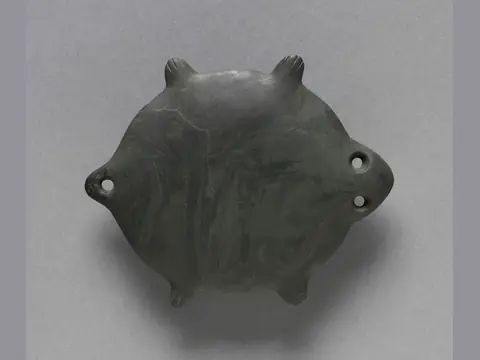
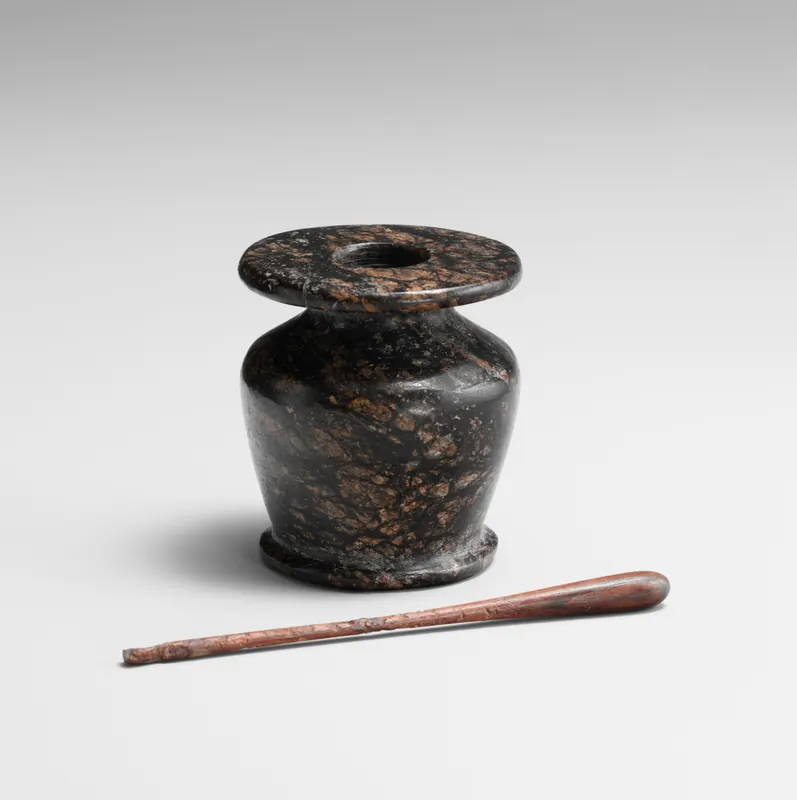
Green was not the only eye colour. Black eye paint was made from galena, a grey-black lead ore found in Egypt's Eastern Desert and along the Red Sea coast 4. The Cleveland Museum of Art's description of a turtle-shaped palette says eye paint was worn by men and women alike, for looks and to protect against sun glare and eye infections 5. Scholars still differ on its purpose; some see a ritual role, a kind of mask 2. Much later, in the New Kingdom, black eye paint was kept in small stone jars with a thin stick to put it on 6.
Sources
- 1. E. R. Ayrton and W. L. S. Loat, Pre-Dynastic Cemetery at El Mahasna
- 2. Matt Szafran, Pigment Processing using Stone Palettes in Predynastic Egypt
- 3. British Museum, Mudstone cosmetic palette in the form of a ram, EA20910 (Naqada I)
- 4. University College London, Digital Egypt for Universities: Cosmetic materials
- 5. The Cleveland Museum of Art, Palette in the Form of a Turtle, 1989.47
- 6. The Metropolitan Museum of Art, Kohl Jar, 36.3.62